
Australia's $10 Billion Grid Congestion Problem — and the AI Solution Already Proven Across 5 Countries
With 7.2 TWh of clean energy curtailed in 2025 and transmission upgrades a decade away, Dynamic Congestion Management offers a faster path — already deployed across five countries and featured as IRENA Case Study #1.
8 min read · June 2026 · Felipe Hödar
The Problem: Australia Is Wasting Clean Energy at Record Levels
Australia's National Electricity Market (NEM) curtailed 7.2 TWh of clean energy in 2025 — a 67% increase from 4.3 TWh the year before. That's enough electricity to power over 1.3 million homes for a year, lost because the grid couldn't absorb it.
The cause is transmission bottlenecks. Australia's grid was built to carry power from centralised coal plants to cities. Now, with renewables distributed across regional areas — often hundreds of kilometres from load centres — the existing lines can't cope.
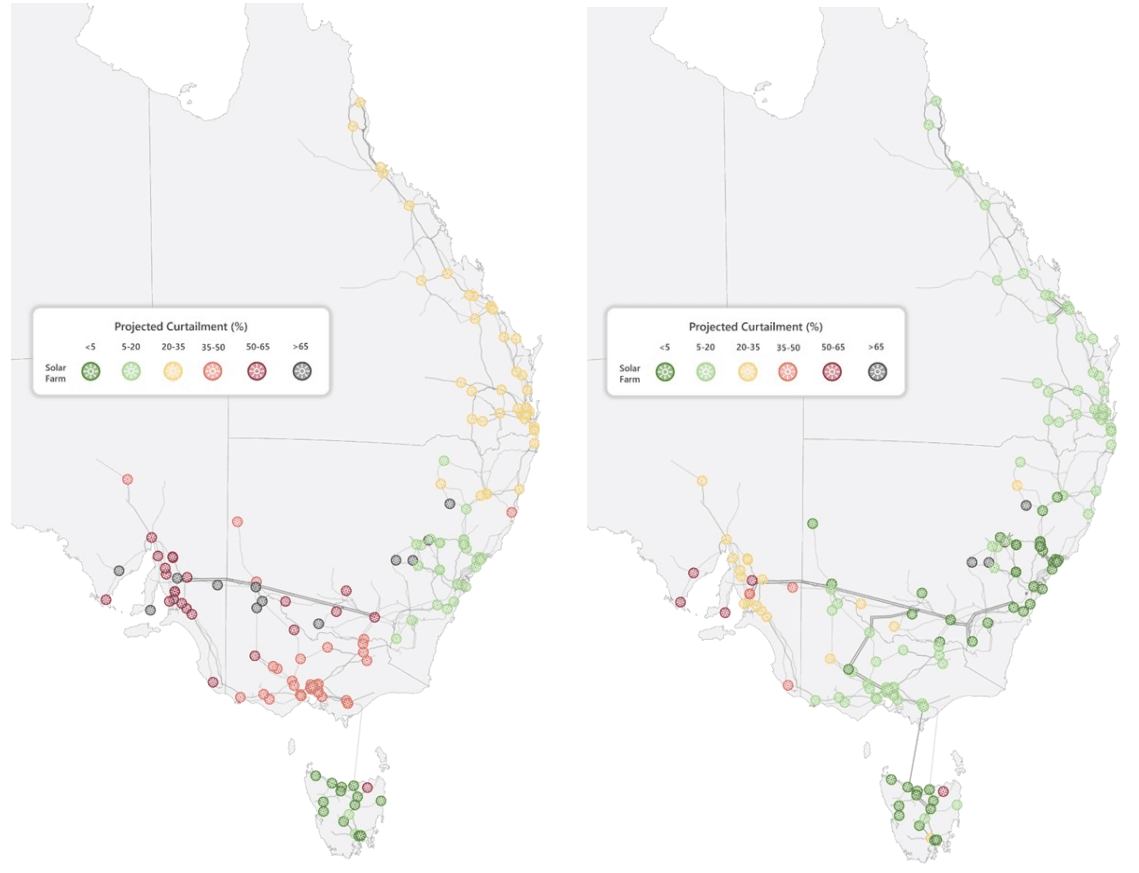
According to AEMO's 2025 Enhanced Locational Information report, new 300 MW solar farms in Victoria and South Australia could face 35–65% curtailment by 2027. For every dollar invested in generation, up to two-thirds of potential revenue could be lost to grid constraints.
The Murray River corridor in Victoria already experienced 13.4% curtailment in 2024–25 — the highest in the state. Several utility-scale solar plants saw curtailment above 25%.
This is already happening.
The Response: Billions in New Transmission — Years Away
Australia's transmission network operators are responding with massive infrastructure proposals:
| Network | Project | Est. Cost | Delivery |
|---|---|---|---|
| Transgrid (NSW) | Sydney Ring South — 500kV line | $3.5 billion | 2030–2034 |
| ElectraNet (SA) | Northern Transmission Project | $3.5 billion | TBC |
| AEMO/AusNet (VIC) | VNI West — NSW-VIC interconnector | $3.3 billion | Delayed to 2030 |
That's over $10 billion in planned transmission upgrades, with delivery timelines stretching 5–10 years into the future.

And history suggests these timelines are optimistic. Transgrid's Project EnergyConnect — a 900 km transmission link between SA, NSW and Victoria — blew out from $1.8 billion to $3.6 billion after contract failures and construction issues. The SA portion was delivered on time and on budget by ElectraNet; the NSW portion is years late and double the original cost.
Meanwhile, the Clean Energy Investor Group's Transmission Bottleneck Analysis warns that capital markets are now pricing “locational constraint risk” — meaning projects that would otherwise be viable are being stranded by transmission timing alone.
Can Australia afford to wait a decade while clean energy keeps getting wasted?
The Alternative: Dynamic Congestion Management
In its 2026 report “Digitalisation and AI for Transforming Power Systems”, the International Renewable Energy Agency (IRENA) featured Splight as Case Study #1 — highlighting their Dynamic Congestion Management (DCM) platform as a proven way to get more capacity out of existing grid infrastructure.

How DCM Works
Unlike Dynamic Line Rating (DLR), which relies on fluctuating weather data, Splight's DCM platform uses real-time grid intelligence, predictive analytics, and precision control to safely operate transmission lines closer to their true physical limits.
Traditional grid planning uses conservative N-1 security rules that typically utilise only 50–60% of a line's actual capacity. DCM identifies and manages the remaining headroom in real time — effectively doubling or tripling the power that can flow through existing infrastructure.
The Results
From IRENA's report:
- •10–12 months to deploy (vs 7–10 years for new transmission)
- •Doubles or triples power flow through existing lines
- •44.4 GWh of clean energy recovered in a single 2024 deployment
- •USD $66 million in additional revenue generated
- •2,000+ km of transmission and 6 GW of assets under management
- •Deployed across 5 countries: US, Chile, Peru, Panama, and Spain
IRENA's executive summary states that Splight's platform delivered “expanded physical grid capacity (doubling the utilisation factor)” — a claim validated through independent case study review.
Why This Matters for Australia
Grid congestion is a global problem, but few countries face it at this scale with this little time. Coal-fired generation is retiring, demand is growing (driven by data centres, electrification, and industry), and renewable generation capacity is far outpacing network delivery. The mismatch will only widen.
Building new poles and wires remains necessary for the long term. But it cannot solve the problem of clean energy being curtailed today.
A technology like DCM offers a bridge:
- •Generates revenue within 12 months — reducing curtailment for existing and new renewable projects
- •Defers or reduces capex — maximising existing infrastructure before committing to multi-billion dollar builds
- •Reduces investment risk — giving developers and investors confidence that their projects won't be stranded by transmission delays
- •Supports grid reliability — using AI to actively manage contingencies rather than relying on static safety margins
For a market where a single transmission project can take a decade and double its budget, a 12-month deployment that doubles line capacity is worth a serious look.
The Opportunity
Splight is currently expanding into new markets, backed by a recent USD $12.4 million funding round led by Blue Bear Capital and ZOMA Capital. Their technology is already proven across utilities, renewable developers, and large loads in five countries.
For Australian grid operators, developers, and policymakers facing an immediate curtailment crisis, what matters now is how quickly AI-driven grid optimisation can be deployed.
The technology is proven across five countries, the business case is validated, and IRENA has put it on the global stage.
Australia's grid needs smarter infrastructure — and it needs it now.
Sources
- AEMO (2025), 2025 Enhanced Locational Information Report — aemo.com.au
- IRENA (2026), “Digitalisation and AI for Transforming Power Systems” — Case Study #1: Splight
- Transgrid (2026), Sydney Ring South Project Assessment Draft Report (PADR) — transgrid.com.au
- RenewEconomy (June 2026), “Network sets out $3.5 billion case for new link to remove bottlenecks” — reneweconomy.com.au
- pv magazine Australia (March 2026), “ElectraNet unveils transmission plans” — pv-magazine-australia.com
- pv magazine Australia (July 2025), “AEMO forecasts increased solar curtailment in NEM” — pv-magazine-australia.com
- WattClarity (Feb 2026), “Keeping up with curtailment 2025: Beneath the headline numbers” — wattclarity.com.au
- CEIG (Nov 2025), Transmission Bottleneck Analysis — ceig.org.au
- Splight (2025), $12.4M Funding Announcement — prnewswire.com
Entering the Australian Energy Market?
Balance Energy helps international energy and mining technology companies enter the Australian market. Let's discuss your go-to-market strategy.